How to Plan Destination Wedding Entertainment — MC, Music & Multilingual Hosting
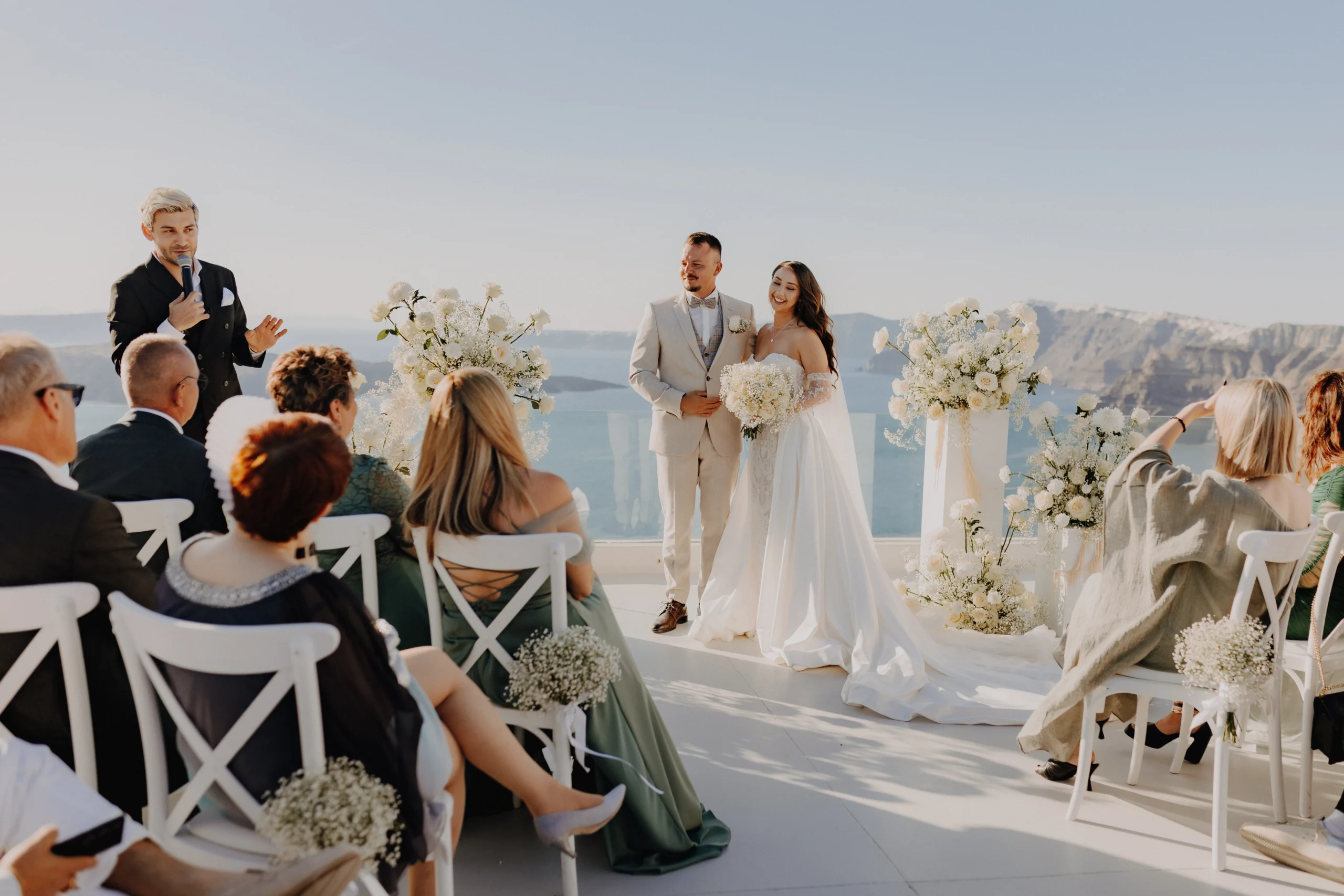
You found the cliffside venue in Santorini. You compared flights for eighty guests. You negotiated the floral arrangement with a Greek florist over Google Translate. But who, exactly, is going to hold the evening together?
Every destination wedding guide out there covers venues, flights, legal paperwork, and flower arrangements. The person who runs your evening — the MC, the emcee, the master of ceremonies — gets one bullet point: “Book entertainment.” As if the gap between an unforgettable celebration and six hours of dead air comes down to a checkbox.
We’ve hosted over 300 weddings across Europe, Africa, and the Middle East — in German, English, and Russian, often all three on the same night. This guide is about the one part of destination wedding planning that nobody covers properly, yet everybody remembers: who holds the microphone and what they do with it.
What Makes Destination Wedding Entertainment Different from a Local Wedding?
At a hometown wedding, most things are forgiving. The DJ speaks the same language as your guests. The venue staff knows the drill. Your best man can grab a spare cable from the AV closet because he lives ten minutes away. A destination wedding strips all of that away.
Guests arrive from different countries, speaking different languages. The venue team operates in Greek, Italian, or Afrikaans. The sunset ceremony starts at 19:47 — that’s when the light hits the caldera, and if the speeches run long, you miss it. “We’ll figure it out on the day” doesn’t work here.
Destination wedding entertainment isn’t about hiring someone fun. It’s about hiring someone who coordinates, translates, adapts, and performs — all at once — in an environment where nothing is familiar and every minute counts.
The Three Roles You Need (and Why Most Couples Confuse Them)
Three roles blur into one during destination wedding planning. They shouldn’t.
Role
What They Do
When They Work
Can They Replace Each Other?
Wedding Planner
Logistics, vendors, timeline, budget
Months before + behind the scenes on the day
No — a planner doesn’t hold a microphone
Celebrant / Officiant
Leads the ceremony, may perform a legal marriage
20–40 minutes during the ceremony
No — a celebrant’s job ends after “I do”
MC / Emcee / Host
Runs the entire reception, coordinates with DJ, manages energy, speaks to guests
6–10 hours on the wedding day
No — an MC is the live face of your evening
A planner makes sure catering arrives at 20:00. A celebrant makes your ceremony meaningful. An MC keeps the six hours after the ceremony from collapsing into awkward pauses, missed cues, and confused guests wondering when the cake gets cut.
One person doing all three? Sometimes possible. Rarely wise. At a destination wedding, the stakes and the logistics are too high to gamble on a single point of failure.
The Language Problem No One Warns You About
A gorgeous villa on Santorini. Eighty guests. The groom’s family speaks German. The bride’s friends flew in from London. The grandparents are from Moscow. The venue coordinator speaks only Greek.
A friend of the couple steps up to the mic: “Can everyone please take their seats for dinner?” Half the room doesn’t move. The grandmother turns to her neighbour, confused. Three tables keep talking. The first dance gets pushed back twenty minutes. The photographer misses the golden-hour shot.
Not hypothetical. That’s what happens at multilingual destination weddings without a professional MC.
A trilingual master of ceremonies doesn’t translate announcements word by word. They read the room live. They sense when to switch from English to German for an emotional toast, when to drop into Russian for the older generation, and when to stay in one language because the energy is too high to break. Not a UN conference — an art form built over years of practice.
Our lead MC, Dima Sol, is a professionally trained actor from London. He hosts weddings in German, English, and Russian — at native level. Not “conversational.” Not “with a slight accent.” Native. That’s what separates a multilingual MC from someone who “also speaks a bit of English.”
Creative moderation for your wedding !
From the welcome to the last dance: we present your event charmingly and professionally.
How to Choose a Destination Wedding MC — 7 Questions Before You Book
Not every emcee who kills it at a local wedding can handle a destination event. Ask these seven questions before you sign anything:
1. What languages do you host in — and how do you switch between them?
A skilled multilingual MC doesn’t translate line by line. They
weave languages so every guest feels included, without the
evening turning into a simultaneous interpretation booth. Ask
for a video. You’ll hear the difference in thirty seconds.
2. How many destination weddings have you hosted?
A local MC might have 200 weddings under their belt — all
within 50 kilometres of home. Destination weddings mean jet
lag, unfamiliar venues, international vendors, and zero margin
for error. Ask specifically about abroad experience.
3. Do you bring your own DJ or work with a local one?
MC and DJ are two halves of the same engine. When the MC
announces the first dance, the DJ has to hit play within one
second — not fumble for the track. At Fasol, every MC works
with a dedicated DJ partner. Not a recommendation. A standard.
4. How do you prepare for the event?
A professional MC wants your story — not just a timeline.
Expect a detailed questionnaire, at least two video calls, and
a custom script built around your wedding. An MC who offers to
“just wing it” is telling you everything you need to know.
5. What’s included in your package?
Travel, accommodation, rehearsal attendance, ceremony hosting,
reception hosting, vendor coordination — all in writing.
Surprise costs on top of destination wedding expenses are the
last thing any couple needs.
6. What happens if you get sick or can’t travel?
Every serious agency has a contingency. At Fasol, our team
includes six multilingual MCs. If one can’t fly, another
steps in.
7. Can you host both the ceremony and the reception?
Some couples book a celebrant for the ceremony and a separate
MC for the evening. Others want one person all day. Dima Sol,
for instance, leads
free ceremonies (freie Trauung)
and then moves straight into the reception programme — no
handoff, no gap.
Destination Wedding Entertainment Timeline — What to Book and When
Timeframe
What to Do
12 months out
Book your MC/emcee and DJ — the best ones fill up a year ahead
9 months out
First call with your MC — languages, guest dynamics, must-have moments
6 months out
MC develops your custom script and programme
3 months out
Final coordination between MC, planner, DJ, venue, and all vendors
How Trilingual Hosting Works in Practice — Three Real Weddings
Santorini — German, English, Russian (80 guests)
Bride’s family: German. Groom’s family: Russian. International friends: English. The split landed at 50% English as common ground, 30% German for emotional moments with the bride’s parents, 20% Russian for toasts and traditions with the groom’s grandparents. The ceremony — a freie Trauung on a cliff — ran in English with German and Russian passages woven into the vows.
Cape Town — English, Russian (60 guests)
South African venue, English-speaking staff, Russian-speaking families on both sides. Split: 70% English, 30% Russian. The MC switched to Russian for the Karawaj tradition (bread and salt) and the Gorko toasts — moments that only land in the language they were born in.
Venice — German, English (40 guests)
A smaller, intimate celebration. Most guests spoke German; the venue team and a handful of friends were English-speaking. Split: 80% German, 20% English. Rather than doubling every sentence, the MC addressed English-speaking guests directly during key moments — keeping the rhythm natural.
What Destination Wedding Entertainment Typically Costs
Numbers first — because “request a quote” with zero context is useless when you’re building a budget.
Service
Typical Range (Europe)
Professional wedding MC / emcee
€800 – €3,000+
Wedding DJ
€500 – €2,000
MC + DJ package
€1,500 – €4,000+
Travel & accommodation (within Europe)
Often included in packages, or €300 – €800 extra
At Fasol, we offer a complete destination wedding package — trilingual MC + DJ — with European travel included. Get a personalised quote based on your destination, guest count, and languages.
Your Destination Wedding Entertainment Checklist
Before you close this tab:
MC/emcee booked at least 12 months out
Languages confirmed, split discussed
DJ confirmed (ideally a fixed team with the MC)
Custom script and programme in progress
MC connected with wedding planner and venue
Travel logistics locked
Backup plan for illness or travel disruption
Ceremony hosting sorted (same MC or separate celebrant?)
Sound equipment confirmed with venue
We handle every one of these as part of our destination wedding service. Not to pad the invoice — but because skipping a single point is how “the best day of your life” becomes “the night the speeches ran two hours and nobody knew when to eat
Planning a destination wedding and wondering who'll hold the room together?
Your destination, your languages, your guest count — we'll handle the rest.